Regions
03:25 PM | 25 Jul 2026
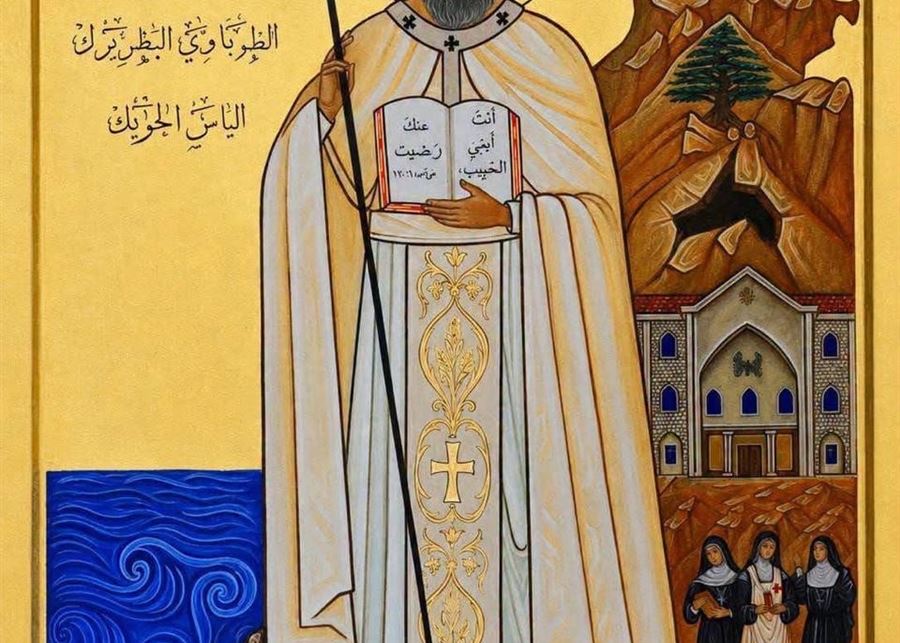
The shepherd signs the official icon of Al-Howayek... What about its symbols?
Fady Mahouly
Today, Saturday, July 25, all eyes are on the patriarchal summer edifice in Diman, where the Maronite Church celebrates the beatification of Maronite Patriarch Elias Howayek, in a historical, religious and national event that is considered one of the most prominent church events in Lebanon, because of the exceptional status that Howayek represents as the founder of “Greater Lebanon” and one of the most prominent men of the church and the country.
The church celebration is headed by Maronite Patriarch Cardinal Mar Bechara Boutros Al-Rai, with the participation of a representative of the Holy See, and the presence of a large number of bishops and bishops, along with official, political, religious and social officials, and thousands of believers who flock to Diman to participate in this event.
The celebration is expected to carry dimensions that go beyond the religious nature, as Al-Howayek symbolizes in the Lebanese national conscience, as one of the most prominent figures who contributed to the consolidation of the Lebanese entity, while the occasion is expected to resonate in Lebanon and the countries of expansion, where his personality enjoys broad consensus on its historical and spiritual status.
Patriarch Al-Rahi signed the official icon of Blessed Howayek, which is the official icon approved in liturgical celebrations.
The servant of the Rachana parish, Father Raymond Basil, explained the symbols of the icon, explaining the following:
The golden halo: a sign of holiness and the blessed one’s participation in the glory of God, not as a human honor, but as an acknowledgment of the work of grace in him.
The hand emerging from heaven (top left): symbolizes the heavenly Father who chose him and sent him as a shepherd for his people.
The dove (top right): A symbol of the Holy Spirit that guided his ministry and inspired his pastoral and national decisions.
The open book: It bears his famous prayer: “You are my beloved Son, I am well pleased with you,” indicating that his life was founded on listening to the word of God and living in His satisfaction.
The patriarchal crutch: a sign of pastoral authority, not as a ruling authority, but as a service to the trust and guarding the flock.
White clothes: symbolize the purity of life, evangelical honesty, and holiness of service.
The church at the bottom right: refers to the Association of Maronite Sisters of the Holy Family that he founded, and to his mission to build the church through education and service.
The three nuns: embody the fruits of his educational and apostolic mission, and its continuation in the Church.
The Lebanese Cedar and Mountain: They symbolize Lebanon, Al-Howayek’s connection to its land and people, and its historical role in defending the Lebanese entity and serving all its people without discrimination.
The sea (bottom left): symbolizes the openness of the Maronite Church to the world, and the hope of believers amid the waves of tribulation.
Golden colors: indicate the presence of the divine kingdom and the radiance of grace.
The straight forward stance: expresses the personality of the shepherd who is steadfast in faith, bold in the truth, and a father present in the midst of his people.
Father Raymond Bassil summarized the significance of the icon as not only presenting Patriarch Howayek as a historical figure, but as a saintly shepherd who lived in the presence of the Father, was led by the Holy Spirit, and made Christ the center of his service. He became a father of the church, a servant of the poor, a builder of the nation, and the founder of a message that continues to bear fruit in the church to this day.