Space & Astronomy
04:41 PM | 10 Aug 2026
An exceptional night... 4 astronomical phenomena coincide on August 12
Fady Mahouly
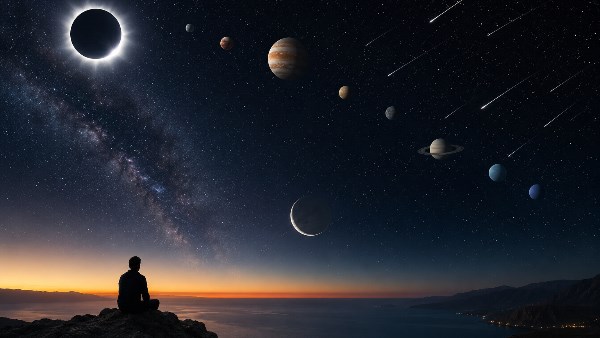
During the night of August 12, four prominent astronomical phenomena coincide: a solar eclipse, a meteor shower, the alignment of six planets, and the new moon.
In general, the month of August is one of the best times for observing the sky, due to the numerous astronomical phenomena and moderate temperatures at night, which provide comfortable conditions for observation, according to Fox Weather.
The appearance of six planets in one celestial scene begins during the hours before dawn on Tuesday, and continues for several nights, according to “The Planetary Society.”
Most observers will also be able to see four planets with the naked eye: Jupiter, Mercury, Mars, and Saturn.
To observe Uranus, a pair of binoculars will be needed, while viewing Neptune requires the use of a telescope.
August 12th: New Moon
The new moon phase contributes to improving astronomical observation conditions, as bright moonlight disappears from the night sky.
The new moon phase is expected to occur at 1:37 PM EST on Wednesday.
On the same day, the world witnesses another remarkable astronomical phenomenon, which is a solar eclipse.
August 12th: Solar eclipse
According to the US space agency NASA, a total solar eclipse will cross areas of northern Russia, Greenland, Iceland, and northern Spain, while a small part of Portugal will fall within the path of the total eclipse.
In the United States, it may be possible to see a partial eclipse extending from Alaska to North Carolina.
NASA also stressed the importance of using eye protection when viewing the eclipse, whether total or partial, such as special eclipse glasses or safe solar filters that block most of the sun's rays and prevent damage to the eyes.
August 12th and 13th: Peak of the Perseid meteor shower
During the night hours from Wednesday to Thursday, the Perseids meteor shower reaches its peak.
This shower originates from the remnants and remains of Comet Swift-Tuttle, and its appearance rate may reach 100 meteors per hour, making it one of the most impressive meteor showers of the year.
While observing conditions this year are expected to be better than usual, thanks to the coincidence of the shower with the new moon, which makes the sky darker.